Compost
What is composting?
Composting is the natural decomposition of organic matter into a nutrient-rich soil additive by way of microorganisms, which use carbon and nitrogen from the organic matter to grow and reproduce, water to digest, and oxygen to breathe. Organic matter can be categorized as either a green or a brown. Greens are nitrogen-rich materials, and browns are carbon-rich materials. So composting can be explained simply through the following equation:
compost = greens + browns + moisture (water) + air
What are the benefits?
- Reduces food waste
- Reduces greenhouse gas emissions
- Increases soil water retention
- Protects environment
- Naturally feeds plants
- Reduces landfill waste
- Decrease soil erosion
- Strengthens soil and plants
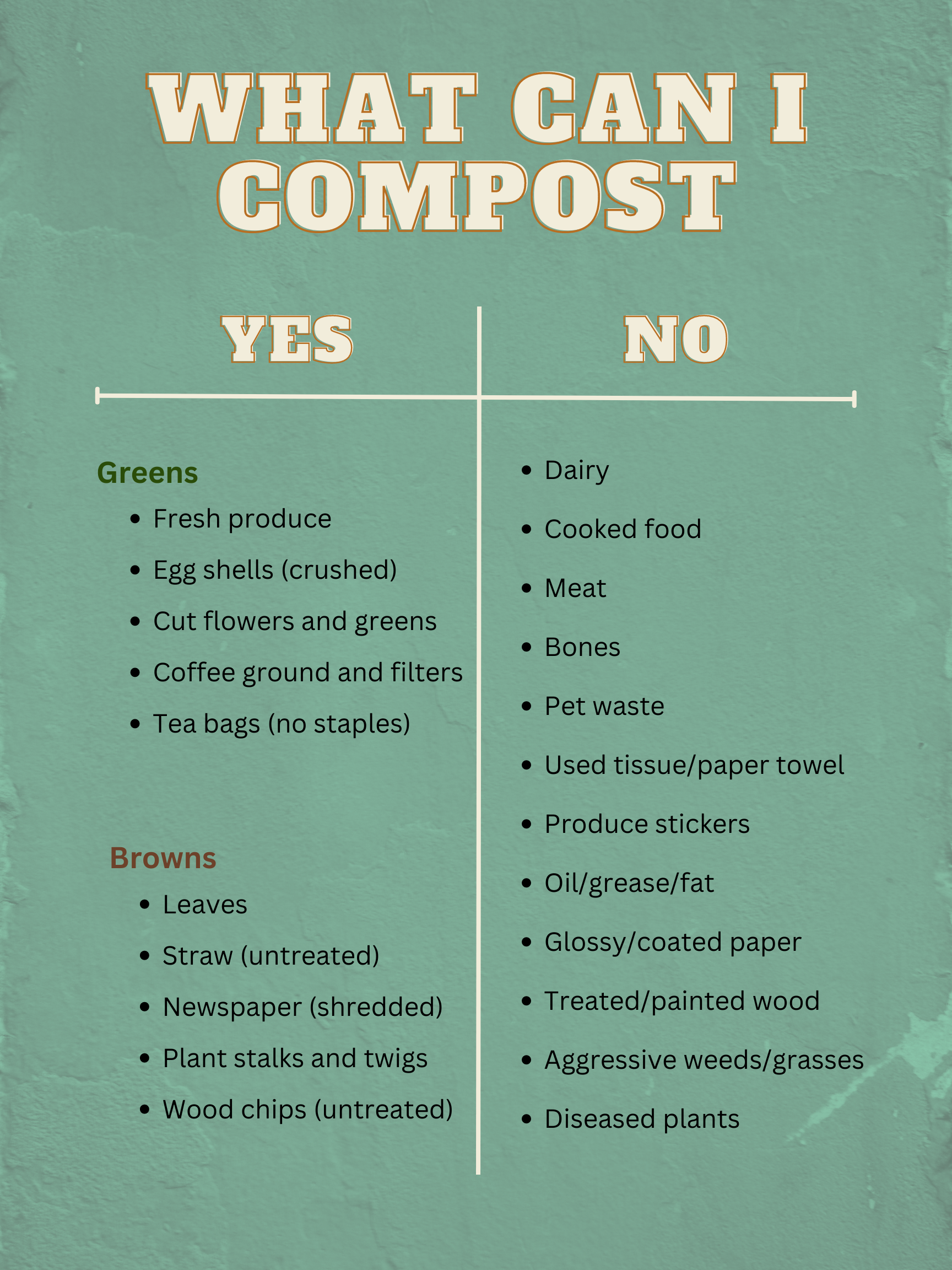
What can I compost?
Yes
Greens
- Fresh produce
- Egg shells (crushed)
- Cut flowers and greens
- Coffee grounds and filters
- Tea bags (no staples)
Browns
- Leaves
- Straw (untreated)
- Newspaper (shredded)
- Plant stalks and twigs
- Wood chips (untreated)
No
- Dairy
- Cooked food
- Meat
- Bones
- Pet waste
- Used tissue/paper towel
- Produce stickers
- Oil/grease/fat
- Glossy/coated paper
- Treated/painted wood
- Aggressive weeds/grasses
- Diseased plants
For a printable version, download the image to the right.
For a printable version, download the image below.
How do I compost?
Donate materials to the SAP
Collect all your food waste materials in a bin and drop it off at the SAP on Luce St. The SAP accepts the following materials:
- All food waste
- Paper plates
- Paper cups
- Napkins/paper towel
- Pizza boxes
- Compostable products (this includes the straws and lids from Campus Dining locations)
- Utensils
Join Ottawa County food composting program
For a small convenience fee, you can join Ottawa County’s food composting program where you drop off your compost materials to any of the Environmental Sustainability Centers in Ottawa County. Different locations are open on different days of the week, so be sure to check out their hours and locations webpage to find the appropriate drop-off location.
The program offers one bag for $5 or three for $12. You can also join the monthly bin exchange program for $40, where you get up to five bins at a time with liners included and unlimited exchanges. The program accepts all food waste, but NO yard waste.
Compost at home
To compost at home, you’ll need an aerated container for your compost pile and four main ingredients: greens, browns, water, and air. You should break down and collect your food scraps in a container inside before throwing them in the compost bin. Try to keep a 3 brown to 1 green ratio for your pile. Always cover your food scraps and greens layer with browns to reduce pests. You should consistently rotate your pile with a pitchfork or shovel to speed up the composting process and ensure even decomposition rates. Keep your compost pile damp. The composting process should take around 3-5 months to complete for a well-maintained pile. When a pile looks ready, leave it untouched for about four weeks to cure, and then you can use it as a soil additive or plant fertilizer.